ev-flow
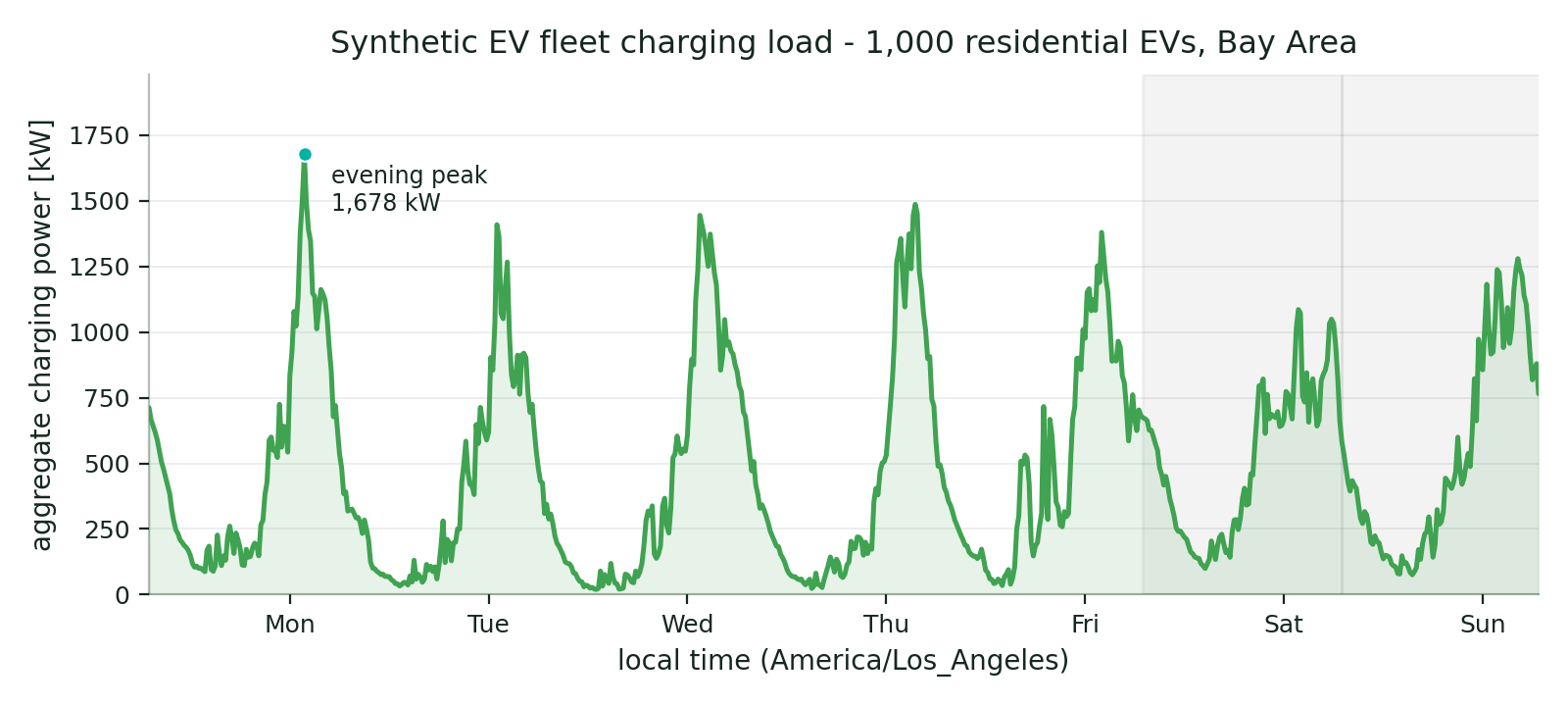
A reproducible, NHTS-grounded synthetic load curve for a 1,000-EV Bay Area residential fleet — from pip install to plot in under ten minutes.




ev-flow generates synthetic plug-in electric vehicle (PEV) charging
behaviour for residential and workplace fleets, grounded in the National
Household Travel Survey (NHTS 2017) travel micro-data and a regional vehicle
sales-mix model. It runs a 9-stage pipeline (NHTS loading, vehicle-archetype
sampling, donor matching, travel-week building, plug-in modelling, state-of-
charge trajectory, and 15-minute / hourly rasterisation) and surfaces the
result through a small, lazy Fleet / Profile library API across eight US
regions — so you can pull plug-in status, charging sessions, SoC trajectories
and aggregate load curves without touching the underlying pipeline.
Install
ev-flow on PyPI, pev_synth in Python
The PyPI distribution name is ev-flow, but the Python import name is
pev_synth. This mirrors the well-known scikit-learn / sklearn
convention: you pip install ev-flow and then import pev_synth. The two
names refer to the same project throughout these docs.
The wheel ships only the Python package — it does not bundle the cached
fleet data, which is built from NHTS 2017 microdata on first run. See the
Quickstart for the one-time bootstrap step before
generate_profiles(...) will return data.
A first look
import pev_synth as ps

ps.list_regions()
# ['bay_area', 'boston', 'chicago', 'dallas_fort_worth',
#  'la_basin', 'new_york_metro', 'seattle', 'us_national']

ps.list_profile_types()
# ['residential', 'workplace']

# After the one-time bootstrap (see Quickstart):
fleet = ps.generate_profiles('residential', n=1000, region='bay_area', seed=42)
prof = fleet[0]

# Boolean plug-in status at 15-minute resolution over a one-week window:
plugged = prof.plug_status('2001-01-01', '2001-01-08', freq='15min')

# Charging sessions intersecting a window:
sessions = prof.charging_sessions('2001-06-01', '2001-06-08')

# Fleet-aggregate charging power (kW) — a load curve:
load_kw = fleet.aggregate_load('2001-06-01', '2001-06-08', freq='1h')
The synthetic cache lives on a 2001 calendar; timestamps in any other year are re-mapped to 2001 (month / day / hour-of-day preserved). The full window and timezone semantics are documented on the API Reference.
Where to go next
- Quickstart — install, bootstrap the data cache, and reach a load curve in under ten minutes.
- API Reference — the full
Fleet,Profile,generate_profilesand region surface, generated from the source docstrings. - Migration — the
ev-flow(PyPI) vspev_synth(import) split, how internal callers thatimport pev_synthkeep working, and the versioning policy. - Issues — report a bug or a validator discrepancy.
- Discussions — ask a question or share how you are using ev-flow.
A note on honesty
ev-flow is built to be truthful about its limitations. The workplace pipeline
is fit from a small (105-vehicle) public EVWatts cohort whose plug-in median
(~12:00 local time) sits about three hours later than the literature-canonical
workplace median (~09:00); the package emits a RuntimeWarning to that effect
whenever you construct a workplace fleet. Vehicle-to-grid (V2G),
smart-charging optimisation, fleet-depot and public-charging behaviours are
not modelled. See the Quickstart for the
workplace caveat in full.
License & citation
ev-flow is released under the MIT License. The MIT license covers the
ev-flow code; the upstream data sources it is grounded in retain their own
licenses and attribution requirements (NHTS 2017, US Census ACS PUMS, EPA
fueleconomy.gov, the Mendeley SPEECh model under CC BY 4.0, and others) — see
ATTRIBUTION.md.
If you use ev-flow in your research, please cite it via the version-independent Zenodo concept DOI:
Travacca, Bertrand. ev-flow: synthetic plug-in electric vehicle charging data. Zenodo. https://doi.org/10.5281/zenodo.20619156
@software{travacca_ev_flow,
  author    = {Travacca, Bertrand},
  title     = {{ev-flow: synthetic plug-in electric vehicle charging data}},
  publisher = {Zenodo},
  doi       = {10.5281/zenodo.20619156},
  url       = {https://doi.org/10.5281/zenodo.20619156}
}
A machine-readable CITATION.cff
is also provided in the repository.